| |
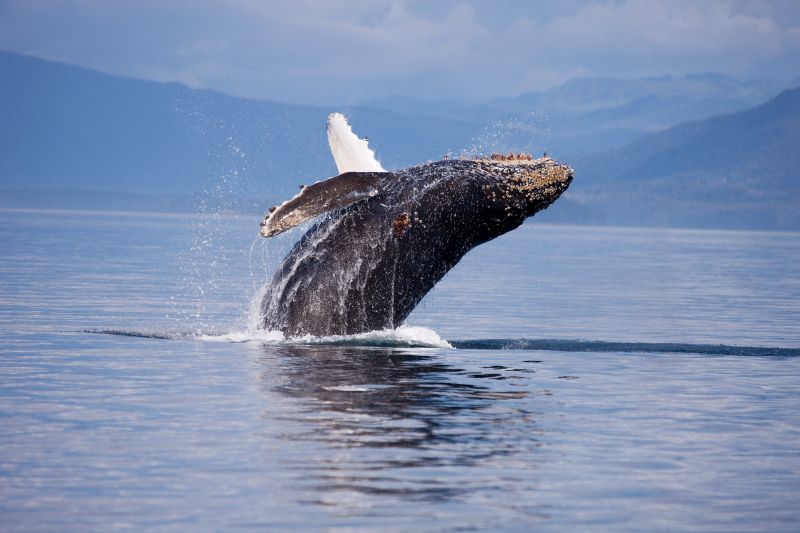
Breaching Humpback Whale |
![]() |
|
|
|
See More Humpback Whale Images : |
Name: |
Humpback Whale |

|
|
Scientific Name: |
Megaptera novaeangliae |
||
Location: |
Inside Passage, Alaska | ||
Status: |
Wild |
Probably the most impressive whale behaviour to see is the humpback whale breaching. To see a 35 ton humpback whale raise its body out of the water is a humbling experience. It is thought that breaching behaviour is important in courtship and play. In this case the whale was on its own and although it could have been signalling to another whale that we couldn't see (a message to say I'm going or I'm here), I just got the feeling that it was playing. |
About Humpback Whales
The humpback whale, Megaptera novaeangliae, is one of the best known and certainly one of the most familiar of the large whales.
Its aerial acrobatics and its ethereal whale song make it a popular choice for whale watching.
Once hunted to near extinction, there are now an estimated 80,000 humpback whales in the world. Name
The humpback whale derives its name from the characteristic hump seen when the whale is diving.
Although other whales arch their back when diving, such as the Sperm Whale, the dorsal fin lies on a thick layer of blubber
and this exaggerates the humpback's hump. |
DescriptionHumpback whales are baleen whales, meaning they sieve small organisms through a plates of baleen in their mouths. Baleen plates look like a very course hair structures organised into a comb like sieve that hangs from the upper jaw. This contrasts with the tooted whales, like the sperm whale, that catch and eat fish in a similar fashion to other toothed animals. Baleen whales are usually bigger than toothed whales and the humpback is no exception, measuring on average 16 meters in length and weighing 35 to 40 tons. This is approximately the same length as a double decker bus or larger. A typical adult male is 11-17 metres and the females are usually slightly larger at 11-19 meters. The largest specimen recorded was 19 metres. A typical calf measures about 4 or 5 meters in length. The most striking characteristic of the humpback are its pectoral pins. At up to 6 metres long, these are the largest pectoral fins of any cetacean. The leading edge of the pectorial fin is lined with tubercules (round nodules) which are actually hair folicles. See insert image. These tubercles increase the humpback whale's aerodynamic efficiency adding to whales agility. A Canadian company has recently desiged a wind-turbine blade inspired by the humpback whale's flipper, (To learn more, see this website ) |
|
All Images Copyright ©Andrew Kelly |